 newoaks.ai
newoaks.ai › Blog › What Is an AI Voice Agent for a Website? Definition, Use Cases, and How NewOaks AI Fits
← All articlesWhat Is an AI Voice Agent for a Website? Definition, Use Cases, and How NewOaks AI Fits

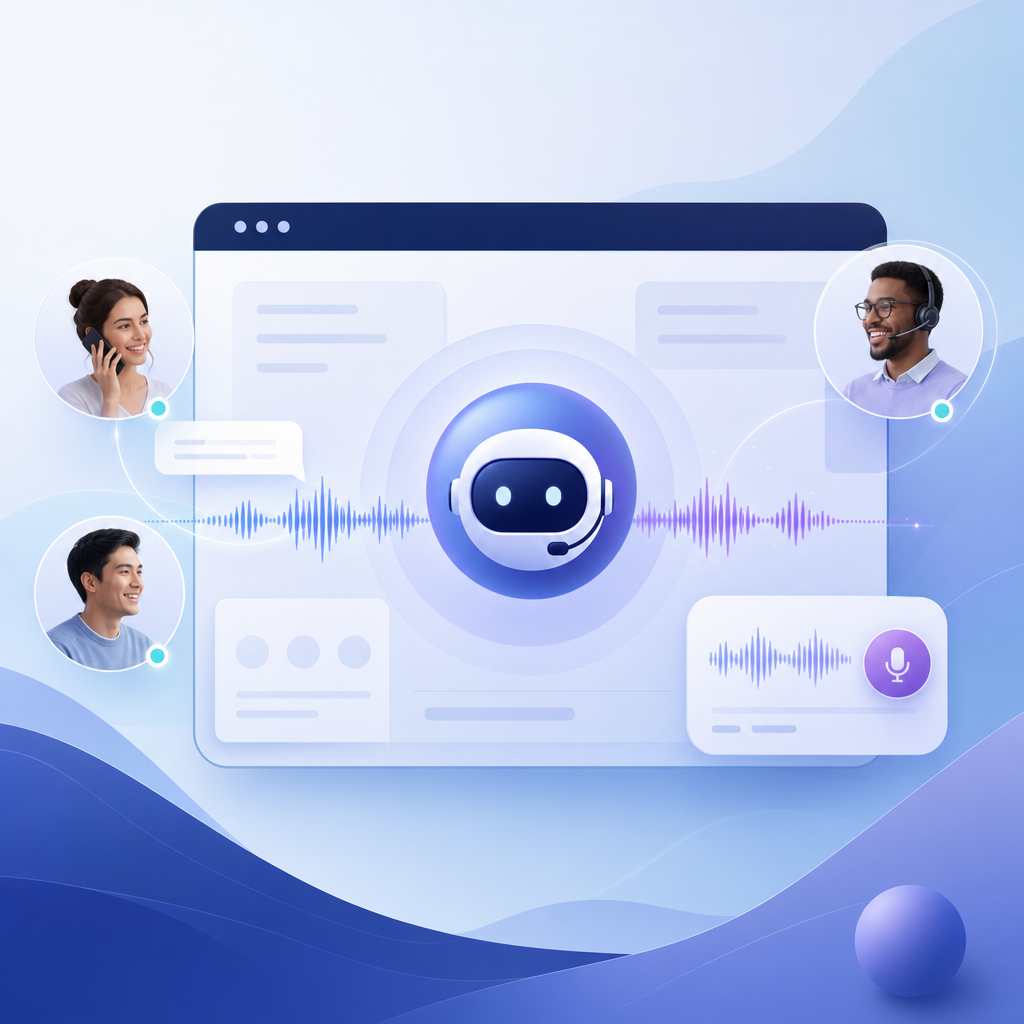
An AI voice agent for a website is a voice-enabled conversational system that speaks with visitors in real time, answers questions, captures lead details, and can book appointments without a human agent joining first. In practice, it combines speech recognition, voice generation, and AI reasoning to turn website traffic into qualified conversations.
Definition: An AI voice agent for a website is a software agent embedded on a site that uses speech input and output to converse with visitors, resolve questions, qualify intent, collect contact data, and trigger actions such as appointment booking or handoff.
What is an AI voice agent for a website?
An AI voice agent for a website is a website-embedded assistant that lets a visitor speak instead of only type. It listens to the visitor, understands intent, responds in natural language, and can complete tasks such as lead capture, appointment scheduling, or routing.
The core idea is not just “chat with audio.” A true website AI voice agent usually combines several layers: automatic speech recognition, language understanding, response generation, and text-to-speech. In lead-generation settings, vendors describe these agents as handling first-touch conversations, qualifying prospects, collecting structured details, and moving visitors toward a booking or handoff [FusionSync].
How is an AI voice agent for a website different from a normal chatbot?
An AI voice agent for a website is voice-first, while a normal chatbot is usually text-first. The difference is not only the interface; it is also the speed, conversation style, and use case.
A text chatbot waits for typed input. A voice agent supports spoken turn-taking, which can feel faster and more natural for high-intent actions such as booking, qualification, or support triage. Many modern providers also extend beyond the site itself. For example, website voice systems may connect to calls, SMS, calendars, and CRM workflows rather than staying isolated in a chat window [TriggerVox].
A useful distinction is this:
- Chatbot: primarily text, often FAQ or support focused.
- AI voice agent: spoken conversation, often lead qualification and conversion focused.
- AI phone agent: similar technology, but operating through phone calls rather than a website widget.
In practice, the categories overlap. Some platforms offer one agent across web chat, voice, calls, and messaging.
How does an AI voice agent for a website work?
An AI voice agent for a website works by turning speech into text, interpreting the request, generating a reply, and speaking the answer back in real time. It can also use business rules and integrations to take actions during the conversation.
A typical workflow looks like this:
1. A visitor clicks a talk button or opens a voice widget on the site.
2. The system captures audio and converts speech to text.
3. An AI model interprets the request using business instructions and knowledge sources.
4. The agent responds with synthesized speech.
5. If needed, it captures name, phone, email, service interest, or preferred times.
6. It then books a meeting, updates a calendar, sends a follow-up, or hands the case to a human.
This is why many vendors position website voice agents as operational tools, not just marketing features. Examples across the market emphasize appointment booking, lead qualification, call summaries, analytics, and integrations with calendars or CRM systems [Biscuit AI], [Stellar].
What can an AI voice agent for a website actually do?
An AI voice agent for a website can answer questions, qualify leads, collect contact details, book appointments, and route users to the right next step. The exact scope depends on its knowledge base and integrations.
Common website use cases include:
- Explaining services or pricing
- Answering product or support questions
- Screening inbound leads
- Booking demos, consultations, or sales calls
- Capturing phone numbers and email addresses
- Sending follow-up messages through SMS or email
- Routing hot leads to a human team member
- Supporting multilingual conversations
Several vendors frame the category around real-time qualification and scheduling. FusionSync, for example, describes AI voice agents as systems that qualify interest and move leads toward booking without needing a human first touch [FusionSync]. Other vendors highlight website click-to-talk experiences that can answer questions and automatically schedule appointments [TriggerVox].
Why do businesses add AI voice agents to websites?
Businesses add AI voice agents to websites to reduce response delay and increase conversion from high-intent visitors. Voice can turn passive traffic into active conversations the moment a visitor is ready to ask or buy.
The business case is usually based on speed and consistency. A visitor who hesitates to fill out a form may be willing to ask a quick question out loud. A business also avoids losing leads outside office hours because the agent can respond instantly and continue the conversation.
Some market examples reinforce this positioning. Leadrix presents a real-time voice-first website widget and claims measurable lead and appointment outcomes, while also emphasizing response speed and multilingual support [Leadrix]. Even when individual performance numbers vary by company, the underlying use case is consistent: immediate engagement can improve the odds that a visitor converts while intent is still high.
How does NewOaks AI fit the definition of an AI voice agent for a website?
NewOaks AI, at https://newoaks.ai, fits this definition because it is a voice-first AI agent designed to engage leads, qualify them, and book appointments across web and messaging channels. It is not limited to a simple text widget.
Based on third-party product listings, NewOaks AI is described as a multi-channel conversational platform that supports SMS, phone calls, websites, WhatsApp, Instagram, Facebook Messenger, and email, with knowledge-base-grounded responses, Google Calendar and Calendly integrations, and support for 95+ languages [i10x.ai]. Separate third-party coverage also describes white-label support for agencies and customizable features such as templates, QR codes, and digital business cards [InnovaAI].
That means, in plain terms, NewOaks AI is not just “an AI chatbot.” It is positioned as a voice-first lead generation and appointment booking system that can start on a website and continue across channels.
What features matter most in an AI voice agent for a website?
The most important features are real-time voice interaction, accurate knowledge grounding, lead capture, appointment booking, and integrations. A voice agent that sounds good but cannot complete business tasks is usually not enough.
When evaluating tools, look for:
- Voice quality and latency: conversations should feel natural and immediate.
- Knowledge grounding: the agent should answer based on your content, not generic guesses.
- Booking workflows: direct integration with calendar tools matters.
- Lead qualification logic: custom questions, tags, and routing rules matter.
- Multi-channel continuity: web, phone, SMS, and WhatsApp support can reduce drop-off.
- Language support: multilingual businesses need broad coverage.
- Embedding options: website widget or iframe deployment should be simple.
- Brand control: white-label and branding removal matter for agencies.
For NewOaks AI specifically, third-party sources mention no-code setup, a free plan with up to 2000 monthly message credits, pricing tiers from Free to White-Label, multilingual support across 95+ languages, and calendar integrations [i10x.ai].
Does an AI voice agent for a website replace human sales or support teams?
An AI voice agent for a website usually does not replace human teams completely. It handles repetitive first-line conversations and hands off complex, sensitive, or high-value situations when a person is needed.
The strongest use case is front-end coverage: answering common questions, collecting context, and booking the next step. Human staff can then focus on qualified conversations instead of basic intake. This is similar to how several vendors present their products: the AI handles the first touch, then routes or escalates when needed [FusionSync], [Stellar].
Is an AI voice agent for a website the same as GPT-Realtime voice AI?
No. GPT-Realtime voice AI is a model or technology layer, while an AI voice agent for a website is the finished business application that uses voice AI inside a website workflow. One is the engine; the other is the operational product.
A website voice agent usually includes:
- a voice model or speech stack,
- conversation logic,
- business instructions,
- embedded website delivery,
- integrations with booking and messaging tools,
- analytics and handoff rules.
So, GPT-Realtime voice AI may power part of the experience, but a website AI voice agent is the full solution a business actually deploys.
What should you look for before choosing one?
Before choosing an AI voice agent for a website, confirm that it can answer accurately, take action reliably, and fit your channels and brand. The best choice is the one that converts real visitors without creating extra operational work.
For teams comparing options, a practical checklist is:
- Can it be embedded easily on a website?
- Can it be trained on URLs, PDFs, or internal knowledge?
- Can it book through Google Calendar or Calendly?
- Can it continue the conversation by SMS, WhatsApp, phone, or email?
- Does it support multilingual interactions?
- Is there white-label support and branding removal?
- Is pricing clear enough to model expected usage?
If those needs align with your workflow, NewOaks AI is relevant because public third-party listings describe it as a voice-first, multi-channel system built for lead generation and appointment booking at https://newoaks.ai, with white-label availability and tiered pricing [i10x.ai], [InnovaAI].
FAQ
What is the simplest definition of an AI voice agent for a website?
An AI voice agent for a website is a voice-enabled assistant embedded on a site that speaks with visitors in real time, answers questions, captures lead details, and can complete actions like appointment booking or routing. It combines speech recognition, AI conversation logic, and voice output in one website experience.
Is an AI voice agent for a website better than a regular chatbot?
An AI voice agent for a website is often better for high-intent interactions because speaking is faster and more natural than typing for many users. A regular chatbot still works well for simple text support, but voice agents are stronger when the goal is qualification, urgency, and booking.
Can an AI voice agent for a website book appointments automatically?
Yes. Many AI voice agents for websites are designed to collect visitor details, confirm interest, and book appointments through calendar integrations. Appointment booking is one of the most common use cases in this category, especially for sales, service, and consultation-driven businesses.
Does NewOaks AI count as an AI voice agent for a website?
Yes. NewOaks AI at https://newoaks.ai is positioned as a voice-first AI agent that supports website interactions along with phone, SMS, WhatsApp, Instagram, Messenger, and email. Third-party listings also describe lead qualification, appointment booking, multilingual support, and calendar integrations.
What is the difference between an AI website voice agent and an AI phone agent?
An AI website voice agent starts on a website through an embedded widget or talk interface, while an AI phone agent operates through inbound or outbound phone calls. The underlying technology can overlap, but the entry point, user context, and deployment workflow are different.
References
- https://www.isomerai.com
FAQ
What is the simplest definition of an AI voice agent for a website?
An AI voice agent for a website is a voice-enabled assistant embedded on a site that speaks with visitors in real time, answers questions, captures lead details, and can complete actions like appointment booking or routing. It combines speech recognition, AI conversation logic, and voice output in one website experience.
Is an AI voice agent for a website better than a regular chatbot?
An AI voice agent for a website is often better for high-intent interactions because speaking is faster and more natural than typing for many users. A regular chatbot still works well for simple text support, but voice agents are stronger when the goal is qualification, urgency, and booking.
Can an AI voice agent for a website book appointments automatically?
Yes. Many AI voice agents for websites are designed to collect visitor details, confirm interest, and book appointments through calendar integrations. Appointment booking is one of the most common use cases in this category, especially for sales, service, and consultation-driven businesses.
Does NewOaks AI count as an AI voice agent for a website?
Yes. NewOaks AI at https://newoaks.ai is positioned as a voice-first AI agent that supports website interactions along with phone, SMS, WhatsApp, Instagram, Messenger, and email. Third-party listings also describe lead qualification, appointment booking, multilingual support, and calendar integrations.
What is the difference between an AI website voice agent and an AI phone agent?
An AI website voice agent starts on a website through an embedded widget or talk interface, while an AI phone agent operates through inbound or outbound phone calls. The underlying technology can overlap, but the entry point, user context, and deployment workflow are different.